Community Based Representation
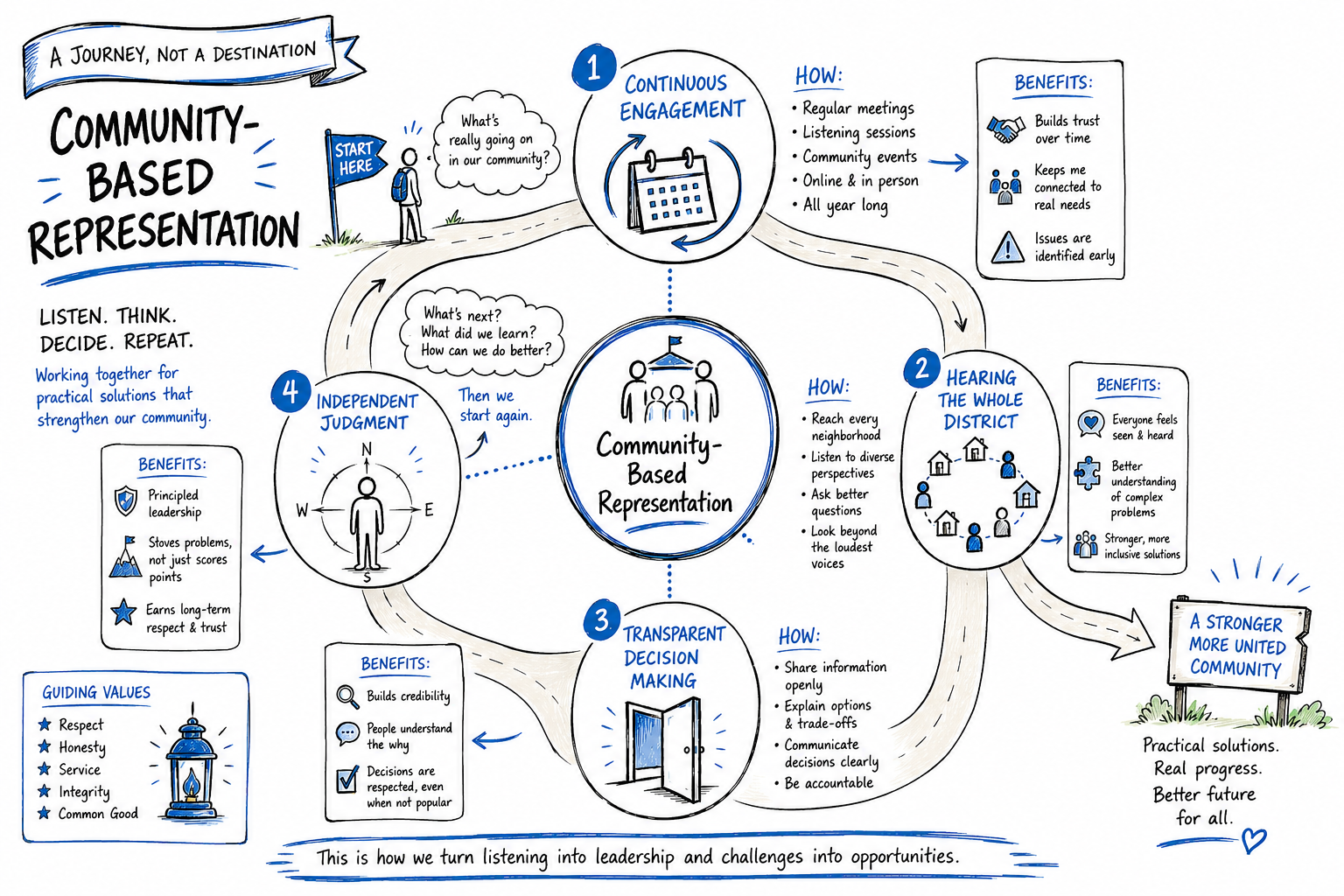
Community-Based Representation is listening continuously, engaging across differences, explaining decisions transparently, and exercising independent judgment when it counts. The rest of this page explains why partisanship makes that standard necessary, and what practicing it looks like.
The Problem
Partisanship is preventing progress. It is driving the United States toward a corrosive state, where political differences divide family and friends, and solutions remain out of reach. Politicians trade insults instead of ideas, and treat the people they serve with arrogance instead of respect.
A Different Standard
Community-Based Representation is not a new theory of government, but a different standard for what a representative owes the people they serve. It does not replace representative democracy with direct democracy, and it does not mean governing by poll or referendum. It strengthens representative government by making listening more deliberate, engagement more continuous, and decision making more transparent.
We need leaders who take direction from all of their community members, including Democrats, Republicans, and the Unaffiliated, rather than from party leaders and ranking members.
Four Commitments
Continuous engagement, not occasional outreach. Listening to a community cannot be limited to election years or moments of crisis. Recurring working sessions throughout the year, where input is gathered before decisions get made, not after. Engagement has to be a standing practice, not something that happens only when attention is politically convenient.
Hearing the whole community, not only those who already agree. A representative who hears only from allies represents only part of the people they serve. Working sessions and open meetings held in every part of a community, not just friendly rooms. Democrats, Republicans, and the Unaffiliated alike deserve to be heard and taken seriously.
Transparent decision making, from process to outcome. An elected official’s schedule posted publicly, so people know who they’re meeting with and why. Every donation and expenditure reported plainly. And every major decision explained: what was heard, what was weighed, and why a particular course was chosen, even when, and especially when, people disagree with the outcome.
Independent judgment, informed by all of the above. Representatives must sometimes make difficult choices when communities disagree or when constitutional obligations require it. Because engagement is continuous, those trade offs get raised early and discussed openly, so a hard vote never comes as a surprise. This does not mean governing by referendum. It means judgment informed by real understanding, not exercised in isolation from it.
What Makes This Different
Many representatives listen selectively to major donors, party leadership, or whichever constituents already agree with them. Others govern primarily by polling, treating public opinion as a substitute for judgment rather than one input among many. Both approaches produce leaders who are responsive to influence, but not necessarily to the people they represent as a whole.
Community-Based Representation rejects both models. Every resident deserves an opportunity to be heard, regardless of financial resources, political influence, or organizational affiliation. Listening should be continuous and comprehensive, while judgment remains the representative’s own, informed by that listening rather than replaced by it.
Listening to constituents is not a novel idea. What’s different is the commitment to practice it consistently, transparently, and without regard to political convenience.
How This Answers the Problem
Community-Based Representation doesn’t eliminate disagreement. It rebuilds the connection that partisanship depends on breaking. When a representative listens continuously across every part of a community and explains their reasoning openly, disagreement stops feeling like betrayal and starts to feel like a normal part of self-government.